Hand the task to the assistant
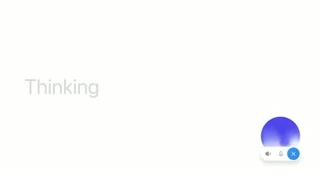
The phrase begins while the orb is small near the lower right and a pale thinking state occupies the left. The change in the pronoun's role is supported by this changed layout, rather than a new camera view.
09 / 12 · Interface demonstration
A voice request accumulates in a quiet composition before the film opens the documents behind it. The recurring orb connects speaking, waiting, inspection and the returned explanation.
Official source: You can just use your voice | ChatGPT Work ↗
01 / A sentence, inspected closely
Select a word to see its corresponding source frame. Use the arrow keys within the word buttons to step through. Frames may stay similar when a shot holds.
“Let me compare those versions.”
Reading · interpretation
The phrase begins while the orb is small near the lower right and a pale thinking state occupies the left. The change in the pronoun's role is supported by this changed layout, rather than a new camera view.
This five-word passage agrees with the available caption text. The full comparison also found differences elsewhere, including a task verb and an ingredient name. Both text sources are machine evidence, and the displayed word onsets are estimates.
The phrase begins while the orb is small near the lower right and a pale thinking state occupies the left. The change in the pronoun's role is supported by this changed layout, rather than a new camera view.
At the estimated onset of the verb, the on-screen sentence is still building its opening. The large text and small orb divide attention between the stated operation and the continuing conversation. The text reveal does not match each estimated word onset exactly.
The sentence continues across the same white field. Its objects are still verbal here; the email and recipe pages arrive later. That delay lets the viewer understand the comparison task before inspecting the material used to perform it.
02 / Directing attention
A narrow rounded text block grows near the top of an otherwise sparse frame, above a blue-purple orb. There is little competing detail while the user adds the comparison, a taste problem and an approval deadline.
The orb moves from a prominent lower position to a small corner presence as status text and then the desktop take over. Its recurrence makes those different views read as parts of the same conversation.
The colorful desktop carries small surrounding files and notes while a central email or recipe window becomes the focus. The answer returns to the sparse white layout, so the viewer can distinguish the consulted material from the explanation derived from it.
03 / Beyond the excerpt
The opening typography proposes voice as the way into the task. A mode switch and an enlarged control show the entry point, then a request about recipe versions builds above the orb. The interface shifts from capturing the request to displaying work in progress. A brief desktop sequence exposes an email and successive recipe documents before the film returns to the conversational layout with a specific ingredient comparison. The closing expands back to the broader product message. The story has a request, supporting material and an answer; the edited status labels do not establish real elapsed time.
Passage boundaries below are approximate. Speech is paraphrased; the word explorer above contains the short quotation. Editorial jobs are interpretations.
No speech was recovered during the opening message and mode selection.
Brief kinetic typography resolves into a voice proposition, then a Chat/Work toggle selects Work.
Editorial job · Introduce the interaction and locate its mode.
A short conversational acknowledgment begins the request.
The voice control is enlarged, activated and replaced by a minimal orb view.
Editorial job · Make the entry action legible before the example develops.
The request compares a newer recipe with earlier versions in email, identifies excessive spice and adds an approval deadline.
The request accumulates in a text block above the orb.
Editorial job · Give the work a specific object, problem and constraint.
A brief handoff leads into the assistant's statement that it will compare the versions.
The orb becomes smaller, status labels change and the assistant's sentence grows across the left of the frame.
Editorial job · Bridge from the request into the work being represented.
No new speech was recovered during the brief document inspection sequence.
A desktop appears, a central email window expands and successive recipe sheets are shown.
Editorial job · Expose the material behind the comparison.
The answer identifies ingredients added in the newer recipe and attributes extra spice to one of them.
The sparse conversational view returns and the response builds above the enlarged orb.
Editorial job · Return a specific explanation to the original problem.
No additional speech was recovered during the closing typography.
The voice proposition returns, followed by product naming, surrounding recipe assets and the closing mark.
Editorial job · Generalize from the example after its answer is visible.
04 / Check the actual image change
These pairs use neighboring decoded source frames. Their timestamps are frame evidence; they do not make the speech alignment exact.
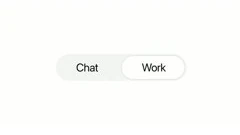
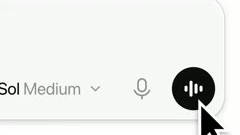
The mode toggle remains at 4.267 seconds. At 4.300 the composition jumps to an enlarged voice control and pointer. The change turns a mode choice into a concrete next action.
Watch around this transition ↗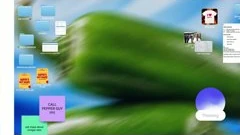
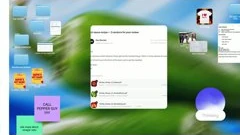
At 23.500 seconds the desktop is visible without the central email window. At 23.533 the window is entering and it continues enlarging through the neighboring frames. The surrounding desktop and orb persist. A scene-change score marks a useful inspection point here, not an edit boundary.
Watch around this transition ↗Proposed use in the all-hands
When a demo crosses conversation, source material and a result, keep a visible anchor and make each view serve one stage of the task. Show the relevant inputs before the answer makes a claim about them. Use the actual Poe workflow and verify any timing claim independently of an edited progress display.
Open the storyboard worksheet →Scope of the reading
This reading establishes the displayed progression, not the accuracy of the recipe comparison, current product behavior or task latency. Full transcripts and caption differences were inspected, but neither the speech nor the soundtrack received direct listening verification.
The full machine transcript was read; 53 estimated words were mapped to source frames. The visual review inspected 80 half-second sample positions, the 5 selected word frames and these 2 native transition windows. Available caption differences were checked. No continuous playback or human listening verification. Method and timing limits.
The earlier reading in the latest-100 study · Structured close readings