16 close readings739 sampled still positions · 8 useful caption tracks
Selected examples from the last year. Sampled visual and caption analysis; no continuous playback or listening review. Method & limits ↗
01 / Find the shape of the argument
Choose a structure for the job.
Start with what the audience needs to understand. Select a job to see a sequence, a source example and a proposed adaptation.
Structure 01
Make a capability matter
01Human difficulty
02Specific help
03A continuing goal
Establish whose work is difficult before introducing the feature. Show the help at the scale actually demonstrated: a plan, a decision or an answer can be a useful result without claiming a transformed life or business.
What does the person need to do next?
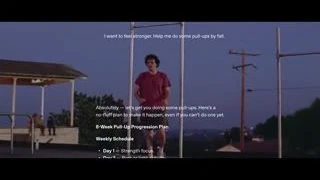
Pull-Up with ChatGPT ↗ · Pull-Up introduces physical effort before the request. The plan supplies a next step; the larger fitness goal remains ahead.
For the all-hands: Open on a concrete difficulty from the recorded account. Connect the demo to that task and name the result it actually supplies.
Keep an artifact, a project identity or a question recognizable as the interface changes. Each new surface should have a job in the same piece of work.
What will the audience recognize in the next scene?
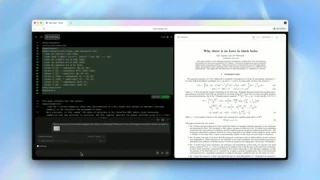
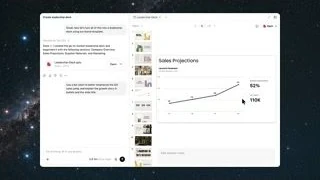
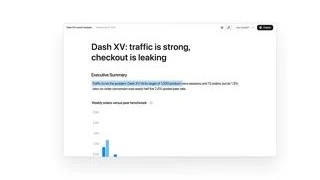
Meet ChatGPT Work ↗ · The lamp project carries research, imagery, a deck and feedback. The chart revision makes control visible after generation.
For the all-hands: Carry real Poe content through the capabilities that belong to one task. Show the consequence of each action before introducing another.
Introduce technical detail when the task needs it. A problem gives the audience a reason to care about the mechanism and a way to judge its contribution.
What difficulty makes this mechanism necessary?
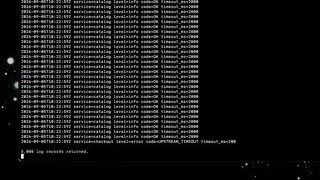
Introducing the Agents API ↗ · The incident investigation creates reasons for filtering logs, delegating work and managing context. A report gathers the result.
For the all-hands: Let the speaker's concrete problem lead the sequence. Reveal the mechanism, then hold the evidence while its meaning is explained.
An early result makes the procedure worth following. One meaningful revision then demonstrates that the audience can direct the result, rather than merely receive it.
What should the audience be able to do afterward?
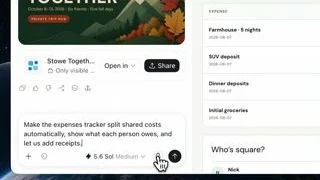
Build a Shareable Site ↗ · The trip-site preview comes before construction. The expense-tracker revision and sharing explanation extend the lesson beyond the first output.
For the all-hands: Preview a real outcome, demonstrate a specific change, and end on the next action that follows from the recorded explanation.
Give the account a change in understanding, a decision or a user encounter. Artifacts make that change concrete and keep a retrospective from becoming only a chronology.
What happened that changed the direction of the work?
10 years. ↗ · The captioned research turning point organizes the anniversary film. Its archive sequence is thematic, not a strictly ordered historical timeline.
For the all-hands: Use verified team artifacts and one consequential turn. Label dates when chronology matters and distinguish present evidence from future ambition.
The audience may need an explanation of trust more than another output reveal. Make the mechanism inspectable and include the human work it depends on.
What would stop this audience from relying on the result?
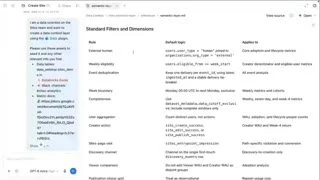
Grounding analysis in a semantic layer ↗ · The definitions document answers a concern about business meaning. Expert review and continuing maintenance remain part of the explanation.
For the all-hands: Name the strongest relevant objection, show how the current product handles it, and preserve any necessary review or limitation.
No matching readings. Try another term or reset the filters.
03 / Compare editorial choices
What changes when the job changes?
The sample supports several structures. Choosing between them is more useful than treating one opening, duration or kind of ending as a universal formula.
An opening sets an expectation
The Codex app tour reaches task entry near the beginning. Its audience is being shown what working in the app involves. The Super Bowl film spends most of its minute on people learning and making before the app appears around 0:50. That delay places the product in a human context.
For an all-hands feature segment, spend opening time on the context the explanation needs. A brand-style introduction can be appropriate when the speaker is establishing purpose; it can crowd out evidence when the speaker is demonstrating a capability. This sample does not establish one ideal reveal time.
Continuity can come from different things
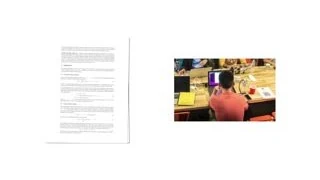
Prism keeps a paper as its recurring result surface. ChatGPT Work carries a lamp project through several kinds of artifact. Atlas instead joins different tasks by increasing delegated responsibility: understand, assist, remember, act.
Write down what survives the transition before selecting its animation. It might be content, a question, a project identity or a rising level of responsibility. If nothing carries over, the next scene may need an explicit new chapter in the recorded argument.
A correction can carry the story
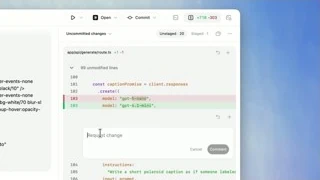
In Work, a chart changes after a targeted request. In the site tutorial, the expense tracker is revised after the initial build. Both make control visible. The Floral Hire supplies a different kind of turn: the founder reports advice to strengthen the existing business before expanding.
A meaningful decision gives a segment a change the audience can understand. Use the correction or choice that actually occurred. Progress may mean improving an artifact, narrowing a proposal, or deciding to wait.
A return to ordinary work after a metaphorical departure
A finished software artifact
The distinction is editorial as well as evidential. Choose the endpoint before arranging the intervening shots. It tells you what the audience needs to see along the way.
Two formats with a different promise
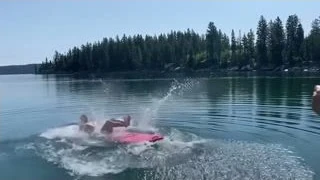
Sora 2 builds breadth through several small events. Each example has an action and a consequence; the setting can change because the event is the repeatable unit. It is useful for a range-of-results segment when the results are meaningfully different.
The Codex brand films use human context or metaphor to position a tool. Their payoff is an invitation or a way of imagining the work. When an all-hands claim depends on actual functionality, pair that motivation with a separate, faithful product demonstration.
04 / Adapt the structure
Build around the supplied performance
Start with a timed transcript of the actual talking-head recording, including pauses. For each substantial point, identify the audience's question, the starting state, the visible change and the evidence that answers the question. A review, permission or limitation needs its own beat when it changes the meaning of the result.
Give each visual a job
In the recorded argument
The presentation can show
Check during storyboard review
A problem or unmet need
The current task, an incomplete artifact or a specific discrepancy
Can the audience recognize the need before the feature arrives?
An explanation of how something works
The real mechanism in the current Poe UI, or a clearly labeled explanatory diagram
Does this behavior match the actual product?
A change in the work
A result that preserves recognizable input or project content
Is the consequence visible, and is the task still identifiable?
A correction or decision
The relevant revision, comparison, review or permission state
Can the audience see what human judgment changes?
A conclusion
The artifact, answer or handoff that supports the spoken claim
Does the evidence answer the question at the right scale?
These are proposed planning choices, not an edit list. Choose the few references that fit the recorded argument and inspect the current Poe product before planning or capturing its demos. Use real UI and original demo material; the source films supply references, not production assets.
Keep the two playback assets separate
The talking head plays through OBS. The companion presentation plays through Google Slides and remains silent by default, so the spoken narration is not duplicated. A tutorial's presenter inset is a reference-film composition, not a reason to combine the all-hands assets.
The presentation opens first. A recognizable content transition cues the manual switch to the OBS scene, which starts the talking-head recording. Measure the actual playback offset in rehearsal: the cue time and the time the recording begins can differ.
The presentation should finish while the talking head's recorded wave and pause are still playing. Compare both files on the shared playback timeline. Opening lead-in and ending buffer are separate requirements, and exact lengths come from the supplied footage and rehearsal.
Use one consolidated storyboard review
Bring the timed storyboard, demo list, selected references, start cue, measured offset and ending buffer into the planned review. Resolve missing footage, material limitations and export requirements there before production. The worksheet below helps collect those decisions; it does not imply that footage has already been supplied or that a production storyboard has been approved.
Turn a spoken point into a visual sequence.
Collect the question, change, proof and timing in an editable worksheet. Export a Markdown draft for the consolidated storyboard review.
This chapter is an interpretive reading of 16 selected official OpenAI films published from September 18, 2025 through September 18, 2026. They were chosen for contrasts useful to this all-hands project: human stories, product workflows, technical explanation, a tutorial, brand films and an output showcase.
The analysis inspected 739 timecoded still positions across 44 contact sheets, spanning films with a combined duration of about 25 minutes. Useful English captions were read for eight films. This is sampled visual and caption analysis. It does not claim continuous playback, a listening pass or frame-accurate cut detection.
Fourteen films have fresh samples at approximately two-second intervals, with a near-end sample where available. Prism uses retained four-second samples after a failed fresh acquisition. The Codex app tour uses retained two-second samples after an interrupted fresh extraction. Those retained sheets were inspected again for this study. A short action or intermediate state can fall between samples.
How to read the evidence
Observed sequence describes what appears in the sampled images or the available caption account. Story function is the author's interpretation of the role that passage plays. Adaptation proposes a use in this project. These are distinct kinds of statement; the adaptations are not official OpenAI production guidance.
Beat ranges are approximate narrative intervals, not exact cut boundaries. The three illustrated samples on each film page locate specific pieces of visual evidence; they do not represent every reviewed position. The compact stills are cropped from the retained contact sheets without adding imagery. Their captions are analysis, not quotations from the films.
Each film page links to its official YouTube source and to the starting time of every discussed interval. Watch the original to assess delivery, sound, motion and the intervening states. Automatic captions were not checked by listening. Atlas's retrieved automatic track contained music labels and stray words and was not counted as useful narration.
What “last year” means here
The channel's Videos, Shorts and Live listings were collected on September 18, 2026. Their union contained 805 distinct IDs, including 461 with publication dates in the rolling year. Forty-two newly found dates were retrieved that day; other inventory dates came from identified September 5 watch metadata. All 16 selected films had their publication dates and official channel identities checked again.
That inventory is a discovery snapshot. It is not a historical archive of deleted or unlisted videos, an independently audited pagination endpoint, or a count of films watched for this chapter. The 16 readings do not estimate channel-wide prevalence, audience response or which approach “performs best.” Twelve subjects overlap the existing 100-film fieldnotes; four are newer September uploads.
Storage and publication
Source acquisitions were processed one at a time in disposable directories. Media, partial downloads, downloader metadata and loose extraction frames were removed after each completed or failed attempt. One early interrupted directory needed explicit cleanup; the collector was then extended to clean its current directory on termination.
The retained research bundle is about 7.3 MB and contains no source videos. The largest recorded completed-video scratch directory was 13.2 MB. The public chapter adds only text, code and selected small stills from that research; it does not upload complete films or caption transcripts. Existing project assets were preserved.
Use the references with their limits
The source films and marks belong to their respective owners. The stills accompany commentary on particular sequences and are not a cleared asset library. Use the current Poe product and original material for the all-hands presentation.
The public reading ledger includes the observations, interpretations, adaptations and illustrated samples. A Markdown edition makes the expanded readings easy to carry into planning. The storyboard worksheet connects the study to a real recording and its separate playback assets.