Attach a source to the request
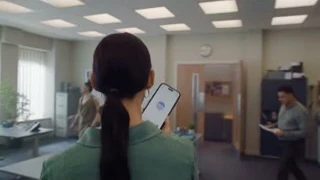
This part of the sentence connects the requested update to its input. The image still follows the protagonist from behind, with the phone and the office ahead of her in the same frame.
08 / 12 · Short brand film
A short request gives the film a concrete task. The surrounding office movement becomes a visual interpretation of coordinated work, while screen inserts carry the actual request, progress and result.
Official source: In Harmony ↗
01 / A sentence, inspected closely
Select a word to see its corresponding source frame. Use the arrow keys within the word buttons to step through. Frames may stay similar when a shot holds.
“with the team's latest meeting notes”
Reading · interpretation
This part of the sentence connects the requested update to its input. The image still follows the protagonist from behind, with the phone and the office ahead of her in the same frame.
These six machine-transcribed words also appear in the later on-screen request. No independent caption track was available. The written request is longer than the recovered spoken sentence and is not a verbatim transcript of it; word onsets remain estimated.
This part of the sentence connects the requested update to its input. The image still follows the protagonist from behind, with the phone and the office ahead of her in the same frame.
The wider office view is present at this estimated onset. People and desks now occupy several depths of the image. That creates a visual association with the group named by the request, without establishing that each person represents a software action.
The last words specify recent meeting material. People continue to cross the office composition while the request finishes. The later screen insert, rather than these background actions, provides the readable task context.
02 / Directing attention
A frontal phone view becomes a rear view and then a wider office angle. This progression keeps the protagonist as the thread while adding the environment in which the request matters.
People cross foreground aisles, work around middle-distance desks and make larger gestures farther back. The seated protagonist supplies a relatively stable focal point in later views. The contrast can be read as a metaphor for work coordinated around one instruction.
The laptop shots identify the written request, progress through connected material and the resulting presentation. The film revisits several slides before returning to the person, so the physical staging is supported by a visible artifact.
03 / Beyond the excerpt
The protagonist speaks into a phone while entering an office. The frame expands to include the people and desks around her, then bridges from the phone to a laptop. A longer written request and a progress list establish the task more explicitly than the brief spoken setup. Office movement surrounds the seated protagonist before the film shows a presentation and several of its slides. A return to her, followed by the closing line over the wider room, joins the concrete result to the film's broader idea of directing work. This is a staged brand narrative, not a real-time record of the workflow.
Passage boundaries below are approximate. Speech is paraphrased; the word explorer above contains the short quotation. Editorial jobs are interpretations.
A brief instruction asks for a launch presentation update using recent meeting material.
A phone request leads from a frontal view to the wider office.
Editorial job · Give the visual sequence a specific task.
No additional speech was recovered in this interval.
A desk view connects phone and laptop, followed by the longer written request.
Editorial job · Bridge the physical action to its screen context.
The opening request remains the verbal setup; no further words were recovered.
The protagonist is followed by close views of the task's progress list.
Editorial job · Make the work behind the request visible.
No additional speech was recovered in this interval.
Office activity continues around desks, a doorway and the seated protagonist.
Editorial job · Develop the film's visual metaphor of coordinated work.
No additional speech was recovered in this interval.
The laptop reveals a presentation, followed by the protagonist and a wide room view.
Editorial job · Connect the surrounding activity to a concrete output.
The result is presented visually; no new narration was recovered.
Several presentation slides are shown in sequence.
Editorial job · Let the audience inspect the type of artifact produced.
The closing message is on screen; the transcript supplies no further spoken line.
The protagonist returns, followed by the wider office and closing typography.
Editorial job · Join the completed task to the brand idea.
04 / Check the actual image change
These pairs use neighboring decoded source frames. Their timestamps are frame evidence; they do not make the speech alignment exact.
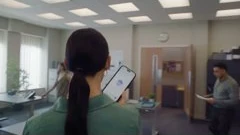
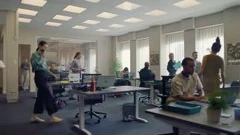
The protagonist's back and phone remain at 2.920 seconds. At 2.961 the wider side view opens the frame to the office. This occurs within the machine-estimated excerpt, but it is not a listening-verified cut on a particular word.
Watch around this transition ↗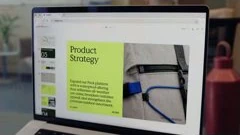
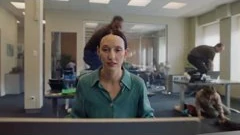
A presentation slide remains at 25.025 seconds. At 25.067 the protagonist returns in a frontal desk view with office activity behind her. The person receives the ending after the artifact has been shown.
Watch around this transition ↗Proposed use in the all-hands
Use one clear instruction to organize a short sequence, and give the audience a visible artifact before the closing claim. If surrounding motion serves as a metaphor, retain enough real product evidence to explain what was actually done. Keep the metaphor's timing separate from any claim about product latency.
Open the storyboard worksheet →Scope of the reading
The machine transcript recovered only the short opening request. That is not a certification of silence or an analysis of the rest of the soundtrack. Office staging is interpreted as metaphor; this study does not verify connector behavior, presentation accuracy, elapsed task time or synchronization to music.
The full machine transcript was read; 14 estimated words were mapped to source frames. The visual review inspected 60 half-second sample positions, the 6 selected word frames and these 2 native transition windows. No independent usable caption track was available. No continuous playback or human listening verification. Method and timing limits.
The earlier reading in the latest-100 study · Structured close readings