Inspection comes first
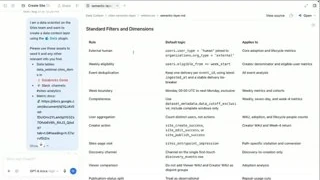
The first verb assigns work to the knowledgeable person introduced in the preceding clause. A populated table remains visible, giving that instruction a concrete object.
01 / 12 · Explanation
The speech makes human review a condition of reuse. The frame keeps the document available as the thing that needs that review.
Official source: Use ChatGPT Work to ground analysis in your semantic layer ↗
01 / A sentence, inspected closely
Select a word to see its corresponding source frame. Use the arrow keys within the word buttons to step through. Frames may stay similar when a shot holds.
“review and refine this.”
Reading · interpretation
The first verb assigns work to the knowledgeable person introduced in the preceding clause. A populated table remains visible, giving that instruction a concrete object.
The four displayed words agree with the retained automatic captions. Their onsets come from machine analysis of the downloaded audio; they have not been checked by listening.
The first verb assigns work to the knowledgeable person introduced in the preceding clause. A populated table remains visible, giving that instruction a concrete object.
The conjunction joins checking to improvement. The images at these word estimates retain the same document composition; they do not demonstrate a person making a correction.
The final word points back to the material already on screen. Keeping it visible supports that reference without adding another title or a new shot.
02 / Directing attention
The opening conversation places two people behind laptops in one medium-wide view. Their shared table and eye lines keep the explanation conversational while the interface is still out of view.
The cut at 34.900 seconds removes both presenters. A narrow prompt/history column stays on the left and the wider document occupies the rest of the image. Scrolling changes the inspected section while that layout persists.
The filter table remains on screen through the displayed review phrase and the following packaging/sharing explanation. The return to the presenters at 60.167 seconds restores the conversation for the wider conditions of adoption.
03 / Beyond the excerpt
The presenters first explain why a data agent needs knowledge that is scattered across people and tools. A document then occupies the frame while the explanation moves through entities, metrics, filters and possible pitfalls. The speaker assigns review to a person familiar with the data before the material can be packaged and shared. The return to the two presenters broadens the discussion to existing semantic layers and the continuing work needed to maintain them. The story therefore qualifies its own promise: supplying a document is one step in an ongoing organizational practice.
Passage boundaries below are approximate. Speech is paraphrased; the word explorer above contains the short quotation. Editorial jobs are interpretations.
An opening topic card precedes the main explanation.
Centered black type appears on white.
Editorial job · Name the question before asking the viewer to follow technical detail.
Trust depends on making distributed organizational knowledge accessible to the agent.
Both presenters remain in a shared table composition.
Editorial job · Establish the problem and the people explaining it before introducing the artifact.
The explanation inventories the kinds of knowledge the document contains.
A full-frame application view moves through document sections.
Editorial job · Give abstract categories visible places in one persistent document.
A knowledgeable person should inspect and improve the material before it is packaged for colleagues.
The filter table stays visible; the document is not replaced by a celebratory result.
Editorial job · Keep the qualification attached to the artifact that requires it.
Existing semantic layers can be reused, but success needs sustained attention from people.
The two-person conversation returns and continues into the closing exchange.
Editorial job · Broaden from the example to the organizational conditions around it.
The main spoken explanation has ended.
The branded ending replaces the table scene.
Editorial job · Close the piece after the argument, rather than using the logo as its proof.
04 / Check the actual image change
These pairs use neighboring decoded source frames. Their timestamps are frame evidence; they do not make the speech alignment exact.
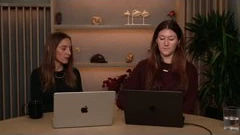
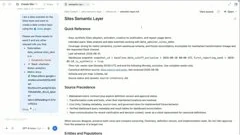
Adjacent source frames change from both presenters to the application at 34.900 seconds. The subsequent demonstrative explanation now has a document to point to. The word estimates do not establish an exact speech-to-cut synchronization.
Watch around this transition ↗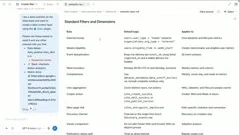
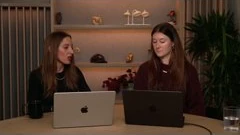
The document is present at 60.133 seconds and both presenters are present at 60.167. That return accompanies the move from explaining the artifact to discussing when an organization should use it.
Watch around this transition ↗Proposed use in the all-hands
When the all-hands recording introduces a review requirement, keep the actual Poe result visible during that clause. Show a real correction if the claim is that a person reviewed and changed it. Time that hold to the supplied recording, then introduce a new composition when the argument moves on.
Open the storyboard worksheet →Scope of the reading
The visible document illustrates the subject of review. This sequence does not demonstrate the review being performed or establish that its definitions are correct. Product names and filler words elsewhere disagree between the two machine text sources and are not treated as certified wording.
The full machine transcript was read; 309 estimated words were mapped to source frames. The visual review inspected 225 half-second sample positions, the 4 selected word frames and these 2 native transition windows. Available caption differences were checked. No continuous playback or human listening verification. Method and timing limits.
The earlier reading in the latest-100 study · Structured close readings