Introduce another route
The clause opens an alternative to the advice described just before it. The picture has cut from the speaker to a close view of hands at a laptop, with an issue-to-agent diagram already present.
02 / 12 · Customer account
The explanation describes several possible outcomes. A diagram turns those alternatives into branches while the filmed workplace keeps the account attached to people.
Official source: Reimagining IT with ChatGPT ↗
01 / A sentence, inspected closely
Select a word to see its corresponding source frame. Use the arrow keys within the word buttons to step through. Frames may stay similar when a shot holds.
“or it's escalated to a human queue with context,”

Reading · interpretation
The clause opens an alternative to the advice described just before it. The picture has cut from the speaker to a close view of hands at a laptop, with an issue-to-agent diagram already present.
The nine displayed words agree with the retained automatic captions. Audio-derived onsets are machine estimates and have not been checked by listening.
The clause opens an alternative to the advice described just before it. The picture has cut from the speaker to a close view of hands at a laptop, with an issue-to-agent diagram already present.
As the clause names escalation and its human destination, the lower branch extends and a staff-member node appears. The graphic supplies spatial structure for the sentence.
The last words qualify the handoff. The diagram identifies the destination but does not expose the transferred context, so that detail remains part of the speaker's account.
02 / Directing attention
Interview crops place the speaker to one side with architectural background space available for diagrams. The early three-layer graphic grows beside the face while the individual, team and company explanation proceeds.
The selected sequence puts white outlined nodes across a close-up of hands typing. It is a graphic explanation over filmed activity, not a readable recording of the agent performing those operations.
At 74.283 seconds the camera angle changes, but the issue, agent and human-escalation route remain visible. The subsequent clause adds a separate upper resolution route, preserving the alternatives already introduced.
03 / Beyond the excerpt
The film moves from an organization-wide argument to several people's accounts of changing IT work. The opening speaker establishes three scales of change: individual, team and company. The help-desk section then describes advice, escalation and resolution as different outcomes. Software governance and reusable team skills provide further examples before the closing return to the opening speaker. The film alternates people, physical work, explanatory diagrams and shown software. Those surfaces serve different purposes: attribution, context, explanation and illustration. The on-screen performance figures add claims beyond the spoken argument; the film itself does not supply an independent measurement of those results.
Passage boundaries below are approximate. Speech is paraphrased; the word explorer above contains the short quotation. Editorial jobs are interpretations.
The opening identifies the IT leader and argues for changing the whole process.
Architecture, walking, a named portrait, interview framing and hands at a laptop establish the people and workplace.
Editorial job · Attribute the account before presenting organizational claims.
The explanation moves through individual, team and company scales, followed by reported gains.
Layers build beside the speaker, followed by a separate throughput graphic.
Editorial job · Keep an abstract hierarchy visible while the speech enumerates it.
The help-desk account describes immediate advice, a human handoff and automatic resolution, then discusses the remaining work for people.
A named speaker alternates with laptop activity, branching diagrams and result claims over workplace footage.
Editorial job · Explain distinct routes without making every task look fully automatic.
The software-governance example describes categorization, assessment and decisions about existing tools.
A new named speaker, meeting views, dashboards and decision graphics replace the help-desk example.
Editorial job · Use a new person and artifact to mark a new part of the argument.
Team knowledge becomes a reusable skill that colleagues can share and keep current.
Another named speaker, typing, a skill label and a readable repository window show the shared material.
Editorial job · End the examples on something that persists beyond one person's interaction.
The opening speaker returns to the organizational case for experimentation.
Interview and workplace shots lead to the branded ending.
Editorial job · Return from the examples to the claim that organized them.
04 / Check the actual image change
These pairs use neighboring decoded source frames. Their timestamps are frame evidence; they do not make the speech alignment exact.
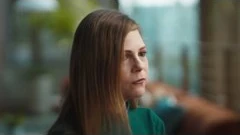

The speaker is visible at 71.697 seconds; hands and the initial diagram replace her at 71.738. This brings the visual model forward as the spoken explanation introduces an alternative outcome.
Watch around this transition ↗
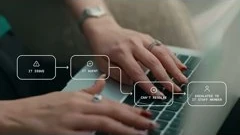
Adjacent frames at 74.241 and 74.283 seconds change the laptop angle. The already-built lower branch survives the cut, leaving room for the next route without making the viewer reconstruct the first one.
Watch around this transition ↗Proposed use in the all-hands
When the recording describes alternatives, give each one a distinct place in an original diagram and retain earlier branches as later clauses arrive. Use a real Poe demonstration to substantiate any claimed behavior; a diagram explains a flow but does not prove that the product performed it.
Open the storyboard worksheet →Scope of the reading
Only the two displayed edit boundaries receive the adjacent-frame verdicts here. The broader chapter intervals are approximate. The diagrams, throughput statements and other result figures are claims or illustrations in the film, not independently established product measurements. The caption track includes a short closing exchange that the machine transcription omits.
The full machine transcript was read; 613 estimated words were mapped to source frames. The visual review inspected 418 half-second sample positions, the 9 selected word frames and these 2 native transition windows. Available caption differences were checked. No continuous playback or human listening verification. Method and timing limits.
The earlier reading in the latest-100 study · Structured close readings