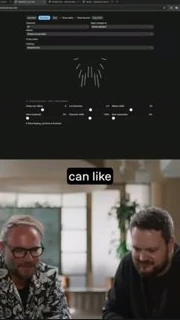
The short moves from a personal account of making a tool to a sustained view of that tool changing. A stacked composition keeps the demonstration and the conversation visible together while the speaker names adjustable properties.
Select a word to see its corresponding source frame. Use the arrow keys within the word buttons to step through. Frames may stay similar when a shot holds.
“change the amplitude of the waves, the line density,”
Decoded frame 36.537 s · first frame at or after the estimated word onset.
Reading · interpretation
Turn the verb into a visible change
At this estimated onset, the upper panel contains a sparse arrangement of strokes. In the following word frames it gathers into the letter shape. The lower panel continues to show the two people looking toward the demonstration.
The selected machine wording is consistent with the burned-in subtitle phrases visible in these frames. No separate usable caption track was available. Subtitle changes and machine word boundaries are not identical clocks; the word timings remain estimates.
Words 1–1
Turn the verb into a visible change
At this estimated onset, the upper panel contains a sparse arrangement of strokes. In the following word frames it gathers into the letter shape. The lower panel continues to show the two people looking toward the demonstration.
Words 2–6
Keep one form available for comparison
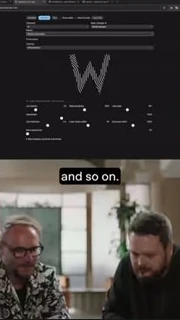
The same letter occupies the center of the upper panel while its line treatment changes. The spoken property has a visible object to attach to. These frames support the observation of variation, without proving which individual control movement caused each change.
Words 7–9
Continue the example instead of changing scenes
The composition holds as the next property is named. The letter breaks into a more open line arrangement across these frames. The stable split gives the viewer a continuing reference for the visual differences.
02 / Directing attention
How the frame supports the sentence.
Give the question its own face
The opening speaker and questioner each receive a close-up. The question supplies a reason to leave the faces and inspect what the tool makes, so the screen material enters as an answer to a conversational need.
Stack the result above its discussion
The portrait frame places software in the upper region and the two-person view below. A central letter is easier to follow at this scale than every small control label. Short subtitle fragments sit near the join, competing with fewer screen details than a full sentence would.
Move from a field of options to one specimen
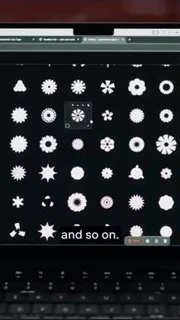
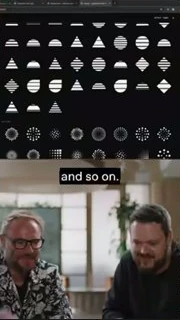
A grid establishes many possible forms. The later isolated letter gives the eye a repeatable object while the settings change. The tool's breadth and the example's legibility are handled in different compositions.
Turn the conversation toward an observable use. ~0:10 ↗The questioner receives a close-up.Give the desire for variation a visible field of examples. ~0:14 ↗A close view of the laptop reveals a grid of varied geometric forms and the hand near the keyboard.Move from a broad library to a specific design question. ~0:25 ↗Software appears above both participants; a single letter, an alphabet grid and another isolated letter follow.Make variation inspectable while its properties are named. ~0:38 ↗The same stacked composition holds as controls and the letter's line arrangement change.
03 / Beyond the excerpt
The full argument.
A close-up opens with a claim about quickly making a design tool. The other participant asks what that enables. A laptop view first supplies a broad field of generated forms; the composition then stacks the software above both participants. The example narrows from a pattern library to a letterform, shows a font grid and returns to a single letter whose treatment changes. Only after this visual exploration does the film return to a close-up for the broader claim about making small tools for designers. The excerpt demonstrates variation within a tool; it does not show the complete process of building it.
Passage boundaries below are approximate. Speech is paraphrased; the word explorer above contains the short quotation. Editorial jobs are interpretations.
The closing generalizes the example to quickly making small tools that support design exploration.
Picture · observation
The film returns to the opening speaker's close-up and ends on his face.
Editorial job · Return ownership of the conclusion to the person after the demonstration.
04 / Check the actual image change
Two transitions in adjacent frames.
These pairs use neighboring decoded source frames. Their timestamps are frame evidence; they do not make the speech alignment exact.
Hard cut from laptop detail to stacked demonstration
Before · 17.518 sAfter · 17.559 s
The laptop fills the portrait crop at 17.518 seconds. At 17.559 the software occupies the upper region and both participants appear below. The subject continues while the composition changes the relationship between the work and its explanation.
The letter and two-person view remain at 41.708 seconds. At 41.750 the opening speaker fills the frame. The return precedes the broader closing statement in the machine transcript and gives that statement a visible owner.
Hold one readable product result on screen while the supplied narration names the properties being changed. Show enough of the real control interaction to establish cause and effect. Borrow this relationship between speech and result while preserving the all-hands setup's separate talking-head and presentation videos.
The review establishes changing forms and the displayed conversational structure. It does not verify the claimed build time, reproduce the tool, establish exact control-to-result causality or listen-verify word timing. The stacked source layout is a research example, not a proposed replacement for the project's separate video assets.
Review basis
The full machine transcript was read; 147 estimated words were mapped to source frames. The visual review inspected 106 half-second sample positions, the 9 selected word frames and these 2 native transition windows. No independent usable caption track was available. No continuous playback or human listening verification. Method and timing limits.