Verification and limits
Project and exports
A separate copy of the downloadable project was installed with npm ci, then
type-checked and tested. The phase tests cover duration extension, invalid
ordering, oversized copy and isolation of sequence timing from content props.
The recording-alignment tests use synthetic fixtures and reject invalid tail
windows, overlaps and inadequate holds; no real recording was synchronized.
All thirteen individual compositions and the complete 1,500-frame / 50-second sequence were rendered in Remotion 4.0.520. Every actual MP4 was fully decoded and checked: 1280 × 720, 30/1 fps, H.264, yuv420p, BT.709 and one video stream with no audio. The default browser-install command also completed, followed by a short CLI render without a custom browser path. Remotion Studio launched and exposed all fourteen compositions.
Frame-oriented checks compare actual decoded exports, not only timeline data:
ChapterReturn: the task before and after the title remains the same.PunchCut: adjacent frames contain a substantial crop discontinuity.CameraPush: an intermediate frame differs from both endpoints.CaptionCut: the caption region remains unchanged within compression tolerance while the underlying shot changes substantially.ScrollMask: the header remains unchanged while the document moves.- Every export: first and last frames of the final hold differ by less than 0.2 mean RGB levels on a 0–255 scale. The sequence's ending comparison is exactly zero. This endpoint measurement is not an exhaustive frame-by-frame optical-flow or human-comprehension test.
The machine-readable export report records durations, frame counts, checksums, checkpoints and measured differences. Encoded bytes may vary across supported browser/OS versions; identical MP4 hashes are not required of another environment.
Source and site checks
Fourteen bounded source excerpts completed actual 1× browser playback, with presented-frame callbacks. The thirteen primary technique windows have 404 decoded consecutive frames in their native subsets; an additional recent film has 60. Annotated frames and written observations identify which exact cuts were visually confirmed. Decoded counts are not a claim that every film in the source inventory was watched frame by frame.
All eleven cited official film pages returned HTTP 200 and the expected video and OpenAI channel identity in a fresh metadata check. Their publication timestamps remain separate from the timestamp of that verification.
The staged chapter passed ten mobile/desktop layouts, actual playback of every original export, phase seeking and decoded-frame stepping, plus a no-JavaScript handoff check. Additional checks covered dark mode, reduced motion, no autoplay and the verification page at 320 pixels. The full-site check inspected 137 HTML pages, 22,789 local links and 2,797 decoded images, with no publication-boundary or prose-secret findings.
On September 5, 2026, all 4,033 served files of the
immutable handoff preview
matched the staged hashes over HTTPS, including the preserved chapters. The
unserved _headers configuration was checked through its actual HTTP response
headers. This is a dated preview check; it does not certify future site changes.
The release builder preserves the 3,926 pre-existing public files. Changes to the 123 existing research HTML pages are restricted to an editing navigation entry and one playbook crosslink; removing those additions recovers each original hash. Existing assets, recipes, evidence and downloads remain byte-identical.
Public-only agent adaptation
An isolated agent received only the immutable published chapter URL and its downloads. It installed the ZIP in a fresh directory, passed typechecking and the supplied tests, downloaded the documented browser, checked Studio startup, and rendered a changed sequence using the documented JSON input. It did not read the repository, edit implementation files or need unpublished guidance. All twenty project files stayed unchanged during that trial. Its original ZIP remains available. The current 26-file download adds the separately tested original-asset example described below; the fourteen default runtime implementations are unchanged.
The adapted sequence changes the opening,
request, result, artifact label and accent to an original purple exhibition
study. Its input JSON sets extraHold: 120,
extending the final tail from five to nine seconds without changing earlier
beats. The exact render command was:
npm run render -- StudySequence out/custom-sequence.mp4 --props=custom-sequence.json --codec=h264 --pixel-format=yuv420p --muted
The actual export was independently rechecked: 54 seconds, 1,620 frames, 1280 × 720, 30 fps, H.264/yuv420p/BT.709, no audio, complete error-free decode. MP4-derived images confirm the changed content and all three motif variants. The final nine seconds were decoded at 128 × 72 and compared throughout; maximum mean difference from the first tail frame was 0.0031 / 255. See the measured report and exported-frame sheet.
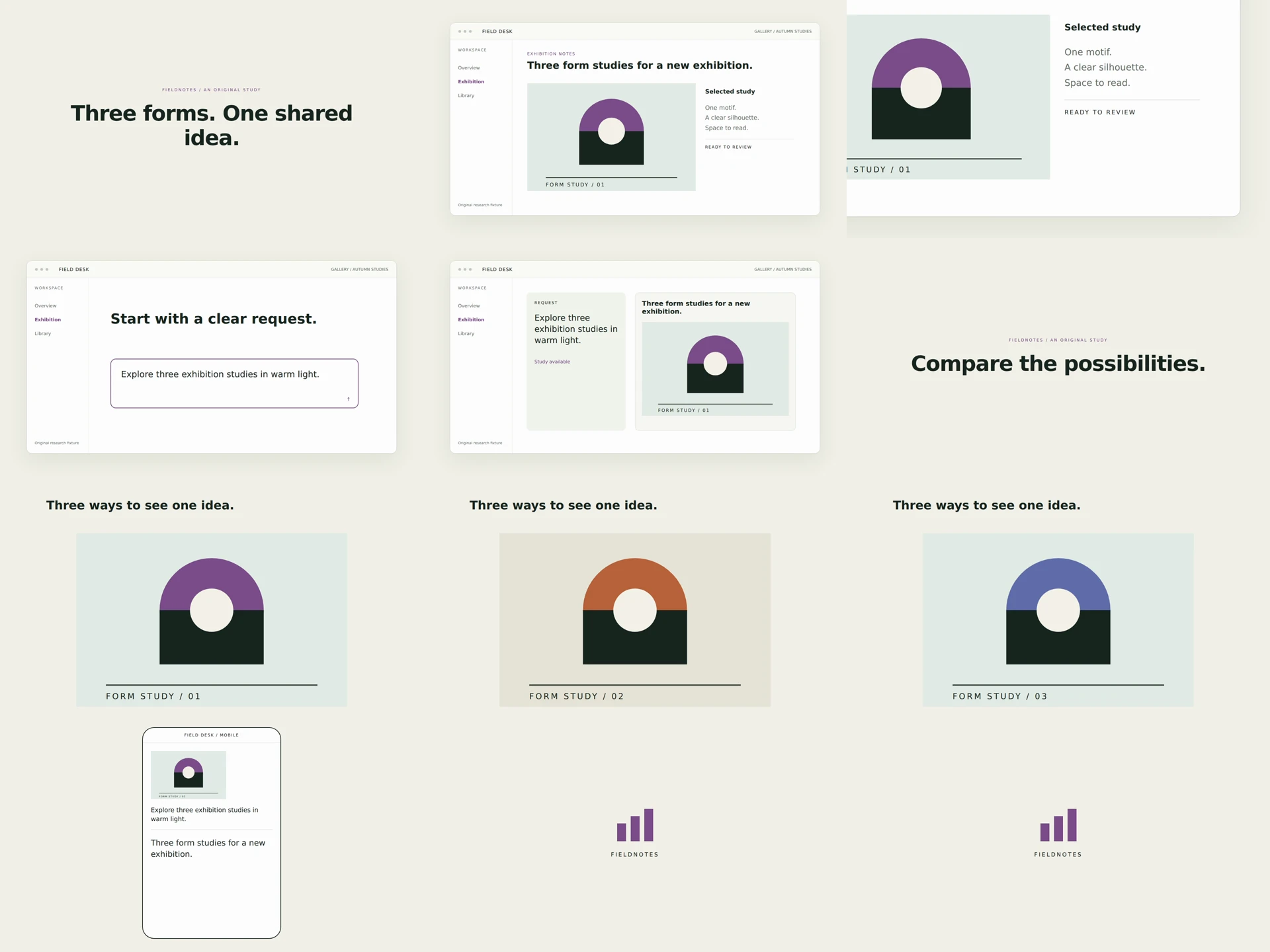
This tested an existing Linux system with FFmpeg and the required system libraries, not fresh OS provisioning. Studio startup was checked over HTTP, not interactively. The trial used full decoding and sampled visual inspection, not uninterrupted human viewing. It is not a recording-aligned presentation.
Remaining boundaries
The collection has 421 in-period uploads; only eleven have a new close inspection in this task. This is not an exhaustive editing census, a recovered OpenAI style specification, or evidence of current product capabilities. Source font files, authoring tools, exact easing, motion-blur settings, unedited waiting times and soundtrack timing are not recovered.
The examples use original neutral graphics. They do not reconstruct branded knot geometry or letter deletion, promise submission behavior absent from the inspected typing interval, or claim a geometric morph where source frames show a cut. Detailed differences are documented alongside every example.
Final presentation production still requires the actual recording, verified product captures, real manual playback calibration, a genuine ending buffer, agreed export settings and one consolidated storyboard/demo approval.
Source-to-export fidelity review
The review used moving source excerpts at 1×, the consecutive source-frame sheets, annotated source states, actual decoded MP4 boundary frames and phase-oriented export sheets. Source and original players were also run side by side at 1×; their unequal durations were not disguised by retiming playback. The acceptance target is the stated editing mechanic, not pixel identity with OpenAI branding or a claim to recover its production settings.
Output frame numbers below refer to each individual recipe at 30 fps, not the 50-second sequence's outer timeline. Source details remain on the linked recipe pages, including publication dates, exact intervals and uncertainties.
| Recipe | Observed mechanic / export boundary | Difference and resolution |
|---|---|---|
| TitleCut | Last inspected source title frame has PTS 19.867 s; browser starts at 19.900 s. Original replaces title at output frame 84, with no dissolve. | Source browser continues enlarging; original arrives stationary. Accepted only as premise/hold/cut, with post-cut camera motion explicitly omitted. |
| ChapterReturn | Task → title → same task context. Original enters title at 30 and returns at 126. | Exact before/after task identity is checked in the original, not claimed as a recovered source backend state. Title wording, metrics and hold are chosen. |
| PunchCut | Source frames 690/691 change crop at PTS 23.033 s without travel. Original frames 53/54 change the crop of the same artifact. | Zoom/focus are chosen. No interpolated intermediate zoom was inserted. |
| CameraPush | Source intermediate magnifications precede a selector menu. Original camera travels during frames 30–45; the action label appears at 66. | Original omits source blur and uses a chosen ease/scale. The target remains readable; cropping the nonessential heading is disclosed in the geometry contract. |
| FocusType | Source field focus precedes text growth. Original pointer approaches during 24–54, then types through 126. | A first-pass placeholder/caret collision was corrected. Shorter original copy, removed final pointer and no submit claim are explicit differences. |
| SelectionContext | Selection, attached action and wider context remain related. Original selects at 30, exposes action at 60 and restores context by 120. | Source selection already exists at the inspected window's start; original selection onset is a chosen addition. No unobserved successful edit is fabricated. |
| ScrollMask | Source content moves under a stationary outer frame. Original translates only the document during 30–84. | Chosen 360-pixel travel lands on row 3. The exported header stays fixed; the destination is stationary before its reading hold. No native scroll-physics fit is claimed. |
| SplitResult | Source opens an empty preview before loaded content. Original narrows the request during 30–66, then settles its result by 114. | Original artwork replaces a running prototype. Completion and the read hold are separate; no source wait duration or product latency is inferred. |
| ObjectContext | Source cuts to an empty phone at 8.133333 s; the request returns afterward. Original cuts at 54, starts returning content at 58 and settles by 84. | Semantic identity survives; size and position do not. The longer four-output-frame blank interval is chosen, not a claimed morph or frame-perfect source gap. |
| CaptionCut | A source caption survives the 9.884875/9.926583 s shot boundary. Original caption appears at 18 and survives the crop at 72. | Original uses a backed artifact identifier instead of a presenter lower third. Decoded caption pixels remain stable within compression tolerance. |
| MotifMontage | Source replaces treatments while retaining a recognizable subject. Original uses three states, with cuts at 24 and 48. | A first-pass fourth variant conflicted with “three studies” and was removed. The 0.8-second chosen cadence is slower than the source's roughly 0.1-second rapid run; this is not a cadence-matched replica. |
| DensityCollapse | Source clears a shrinking image group before its sparse title. Original group collapses during 84–108 and is replaced at 108. | Internal card motions and blur are simplified; common group ownership and clearing order are retained. The 24-frame collapse is chosen. |
| QuietEnding | Source identity motion precedes later stable-looking ending samples. Original exits proof at 30, builds its mark from 54 and is stable at 90. | Three original bars replace branded letter deletion and knot motion. The original's fixed final hold is verified; source sampled stillness is not overstated as an every-frame freeze measurement. |
The composed sequence was also corrected to use a comparison-specific montage heading rather than repeating the opening premise. It intentionally previews the result before explaining the request, and later returns from phone to desktop proof by a cut. Those returns are editorial choices, not hidden product actions. The complete final 50-second playback and ending frames were checked.
Unresolved source knowledge is not filled in with implementation guesses. Exact source easing, motion blur, authoring settings, font files, unedited task latency and universal reading budgets remain unknown. Compressed waits are an explicit evidence gap. The supplied geometry, phase frames and holds are complete, testable choices for original work within those limits.
Fresh-context asset adaptation
On September 5, 2026, a separate agent received only the downloadable project and its guide, without repository or private product context. It replaced the fixtures in CameraPush and MotifMontage with an original fictional trail map and four distinct route-badge treatments, then rendered a new 13-second sequence. The map is an illustration, not geographic or navigation data.
The trial exposed three gaps: a concrete asset-replacement example; complete
two-recipe registration, font loading and local clocks; and diagnosis of a
restricted-host failure. The project now includes ASSET_ADAPTATION.md and
five complete files under examples/trail/. The example has a separate entry
point and does not change the fourteen default compositions.
A fresh extraction of the revised 26-file ZIP passed npm ci, typechecking
and all tests. The agent rendered the documented TrailSequence entry without
editing any archived source file. Its final export has 390 frames, 13 seconds,
1280 × 720, 30 fps, H.264/yuv420p/BT.709 and no audio; full decoding completed
without errors. The original thirteen recipe exports and 50-second sequence
retain their previously inspected source and rendered bytes.
Host-qualified rendering result
On the restricted test executor, the documented Node interface-enumeration
preflight and unassisted render both failed with os.networkInterfaces() /
errno 97 before evaluating a composition. The successful retest used an
explicitly disclosed, external process-only loopback-interface adapter.
No project or Remotion dependency was patched; the adapter is not included in
the download. This is not an unassisted render success on that host.
The guide distinguishes that restriction from missing Chrome libraries and
directs users to a supported host. The earlier default-project clean render
and browser-install checks remain separate evidence.
Rendered comparison
The first adaptation exposed a map layer leaking behind a fixed footer during the push. Full-width frame-space masks fixed it before acceptance. The complete corrected sequence was played at 1×; the final packaged-example render was then compared with that accepted export across all 390 decoded frames and 21 selected boundary, motion and hold frames.
All 210 montage frames match exactly. The camera shot has small raster differences: whole-sequence SSIM is 0.999557 and frame 84's mean absolute channel difference is 0.2824 on a 0–255 scale. Side-by-side and amplified differences show no material timing, geometry, text, mask or continuity regression in the inspected frames. The precise cause of the raster differences was not established. The exports are not pixel-identical. The failed strict-equality check is retained in the local evidence; it is not reported as a pass.
These checks resolve the three guidance gaps. They do not prove that arbitrary replacement assets will fit, that every host can render, or that an actual talking-head recording has been synchronized. The separate-video workflow, real-recording timing and storyboard approval boundary still apply.