Technique / CameraPush
Move the camera, then expose the action
Guide attention toward a target after establishing the workspace.
Run the original
Original neutral assets · 5.2 seconds · phase values are chosen defaults, not source timings.
npm run render -- CameraPush out/CameraPush.mp4 --codec=h264 --mutedDownload the complete pinned project · Inputs, phase meanings & full source code
Official source / inspected interval
A first look at the Codex app
Watch the official OpenAI upload ↗ · Published 2026-02-02T10:03:33-08:00
Inspected 3.4–5.8 s. Consecutive subset: 3.85–4.5 s, 15 frames. Dates come from the official watch-page publication field.
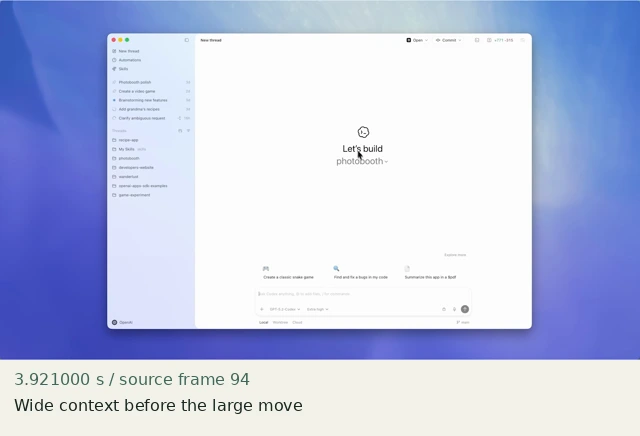
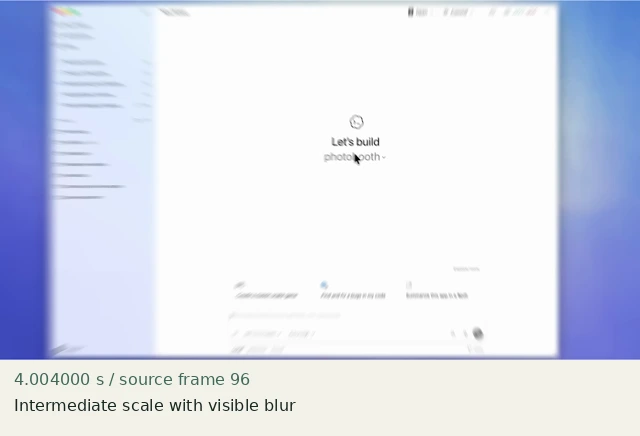
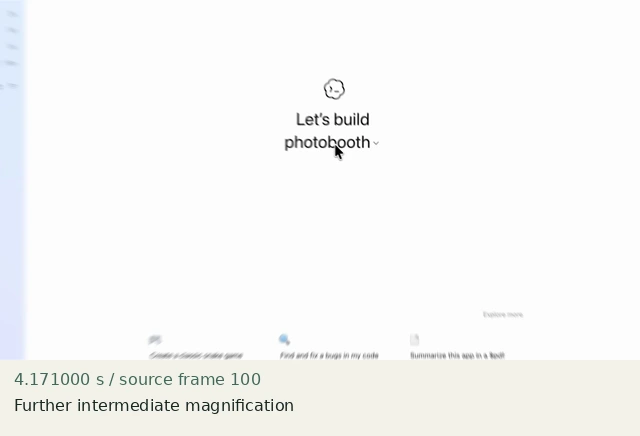
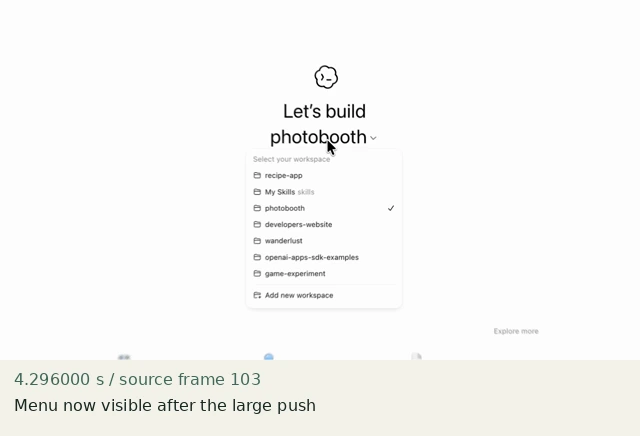
Source: OpenAI. Bounded excerpt and annotated stills for the analysis below; not included in the project download.
What changes across the edit
- Shot boundary
- No cut is claimed during the inspected push: multiple intermediate magnifications are visible.
- Framing
- The complete window grows beyond the frame edges and brings the workspace selector forward.
- Layer ownership
- Window and native cursor participate in the source framing; the selector menu is an internal UI layer.
- Motion
- Large scale changes around 3.963–4.255 s precede the visible selector menu at 4.296 s. Motion blur is visible in intermediate frames.
- Typography
- Existing application type scales with the camera; no new chapter copy.
- Action order
- Wide context → rapid push → menu appears → menu remains readable.
- Pacing & readable holds
- The menu is visible in the 4.296–4.463 s consecutive frames and later overview samples. No exact fitted settle threshold.
Recreation versus observation
Matches
Shared workspace camera, short attention move, then an action label at rest.
Differs
No source motion blur, exact zoom or easing reconstruction. The supplied cubic Bézier and 15-frame travel are chosen.
Measured
- Intermediate source frames 96–102, 4.004–4.255 s; menu visible at frame 103, 4.296 s.
Inferred
- Menu follows the large push; residual motion is not claimed to be exactly zero.
Chosen defaults
All Remotion phase frames, cubic Bézier (.16,1,.3,1), geometry, colors, font choice and reading holds are chosen defaults. None is a recovered OpenAI specification.
{
  "title": "Make room for the idea.",
  "prompt": "Arrange a small exhibition.",
  "result": "Three studies, ready to compare.",
  "label": "EXHIBITION / 03",
  "accent": "#40685b",
  "action": 30,
  "change": 45,
  "settle": 66,
  "hold": 90,
  "focusX": 0.66,
  "focusY": 0.64,
  "zoom": 1.55
}
Increase hold to extend only the final quiet state. Change the phase frames to change choreography; preserve their ordering. Content limits and the exact meaning of each phase are in the handoff.
Exact original geometry, layer ownership and asset contracts · Schedule against an actual recording