Invite a possibility
The sentence begins as an invitation. The image shows a researcher using a microscope, locating the imagined object in a recognizable practice before showing any product interface.
06 / 12 · Research portrait
The opening does not illustrate every noun literally. It places a computational promise over physical laboratory work, then uses repeated biological imagery to connect methods, stakes and aspiration.
Official source: Discovering new antibiotics with ChatGPT ↗
01 / A sentence, inspected closely
Select a word to see its corresponding source frame. Use the arrow keys within the word buttons to step through. Frames may stay similar when a shot holds.
“Imagine a molecule that you created on a computer”
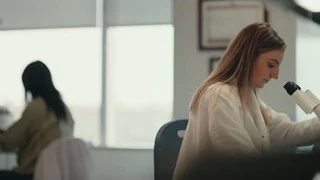
Reading · interpretation
The sentence begins as an invitation. The image shows a researcher using a microscope, locating the imagined object in a recognizable practice before showing any product interface.
These nine words come from the local machine transcript. No independent usable channel caption track was available. Treat the wording and individual onsets as provisional until checked by listening to the official source.
The sentence begins as an invitation. The image shows a researcher using a microscope, locating the imagined object in a recognizable practice before showing any product interface.
A close view of a gloved hand adjusting the microscope replaces the wider laboratory view during this clause. The action provides a concrete detail of work rather than an illustration of a finished therapeutic result.
The phrase names the computer while the microscope detail remains. The image and words carry different parts of the idea: a computational method and the physical world it concerns. The opening subsequently cuts into microscopic imagery.
02 / Directing attention
The opening moves from a researcher at a microscope, to the focusing control, to a circular microscopic image. That progression gives the audience a route from person to action to the material under study.
Colorful biological patterns recur behind archival-style pictures, behind a researcher at a desk and across the closing portraits. Read as a motif, they connect nature, data and the people examining it. They do not establish a scientific result by themselves.
The computer views include hands, reflections, angled displays and colleagues looking together. They locate the tool within laboratory practice. The film is not structured as an isolated sequence of product controls and responses.
03 / Beyond the excerpt
An invitation to imagine a useful molecule opens over microscope work. The film contrasts gathering material in nature with computational investigation, then introduces the scientific and human stakes of antibiotic research. Laboratory actions, discussions, screens and illustrated examples give that large subject several scales. The final passage returns to the hope that this work might help people. That ending matters: the desired human benefit is presented as a goal, while the visible evidence remains research activity, visualizations and testimony.
Passage boundaries below are approximate. Speech is paraphrased; the word explorer above contains the short quotation. Editorial jobs are interpretations.
The opening invites the viewer to imagine a computer-designed molecule with a human benefit.
A researcher, a microscope control and biological imagery form a sequence of changing scales.
Editorial job · Connect the proposed method to a physical purpose.
Gathering material in nature is contrasted with computational work.
A person among plants leads into inset images of field collection over colorful patterns.
Editorial job · Give the older search process a concrete form.
The narration introduces computational assistance and a claim about accelerating discovery.
Colleagues, code, pipetting and a projected-pattern title sequence.
Editorial job · Establish the working world and the film's subject.
The narration explains why effective antibiotics matter and describes the stakes of resistance.
Laboratory actions and a group discussion lead to medical illustrations.
Editorial job · Make the motivation larger than a software task.
Biology is described as information, with several sources of molecular investigation.
Chat and code views, researchers, projected patterns, animal illustrations and a molecular visualization.
Editorial job · Move between the computational idea and examples of what it examines.
The account describes broader access to computational analysis and algorithms.
Colleagues work together; angled displays show chat, code and data.
Editorial job · Locate the tool's role within ongoing research.
The narration returns to biological complexity and identifying patterns.
A meeting, plant-filled surroundings and a montage of biological forms.
Editorial job · Reconnect the technical work to the larger field of inquiry.
The closing describes the hope that the work could help people and the motivation to continue.
A reflective desk portrait, screens, projected imagery and smiling colleagues lead into the brand ending.
Editorial job · Resolve the portrait with an aspiration, not a demonstrated clinical outcome.
04 / Check the actual image change
These pairs use neighboring decoded source frames. Their timestamps are frame evidence; they do not make the speech alignment exact.
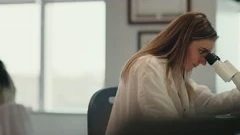
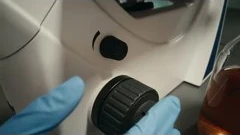
The researcher at the microscope remains at 1.835 seconds. At 1.877 the frame changes to a gloved hand on its focusing control. The object and activity maintain continuity while the scale tightens.
Watch around this transition ↗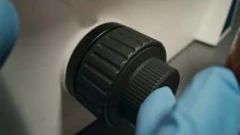
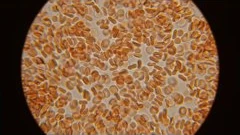
The focusing control remains at 3.587 seconds. At 3.629 a circular microscopic image replaces it. This completes the opening's progression toward the material being examined; it does not identify a particular molecule or outcome.
Watch around this transition ↗Proposed use in the all-hands
For a human account, let the pictures establish the real work, people and stakes around a product. A visual need not repeat the spoken noun if it adds necessary context. Keep ambitions and achieved results distinct: if the recording expresses a future hope, do not give it an image that implies the outcome has already occurred.
Open the storyboard worksheet →Scope of the reading
The transcript is machine-only and includes uncertain proper names and a brief conversational interjection. This reading makes no claim about vocal delivery or speaker attribution. Laboratory footage and scientific illustrations do not independently establish efficacy, clinical benefit or the narration's scientific claims.
The full machine transcript was read; 320 estimated words were mapped to source frames. The visual review inspected 259 half-second sample positions, the 9 selected word frames and these 2 native transition windows. No independent usable caption track was available. No continuous playback or human listening verification. Method and timing limits.
The earlier reading in the latest-100 study · Structured close readings